
OpenAI Shipped Two New Models on April 23, 2026
Yesterday, OpenAI released GPT-5.5 and GPT-5.5 Pro, the first fully retrained base model since GPT-4.5. GPT-5.5 is rolling out to ChatGPT Plus, Pro, Business, and Enterprise users. GPT-5.5 Pro is available to Pro, Business, and Enterprise only. Both ship with a 1M token context window.
If you're using Claude Opus 4.7 today through Claude Code, Claude.ai, or the API, you have a legitimate question on your hands: is it worth switching? The short answer for most Claude Code users is no. The longer answer has some real nuance, because each model actually wins in specific workloads.
Here's the honest benchmark picture, the pricing math, and the decision framework, based on published results from April 23-24.
TL;DR
- GPT-5.5 is a solid base-model upgrade from GPT-5.4, with meaningful gains in agentic coding, computer use, and scientific research workflows. 1M context window matches Claude's upper range.
- GPT-5.5 Pro is the same lineage with higher-accuracy tuning, priced significantly higher: $30 input / $180 output per million tokens versus $5 / $30 for standard 5.5.
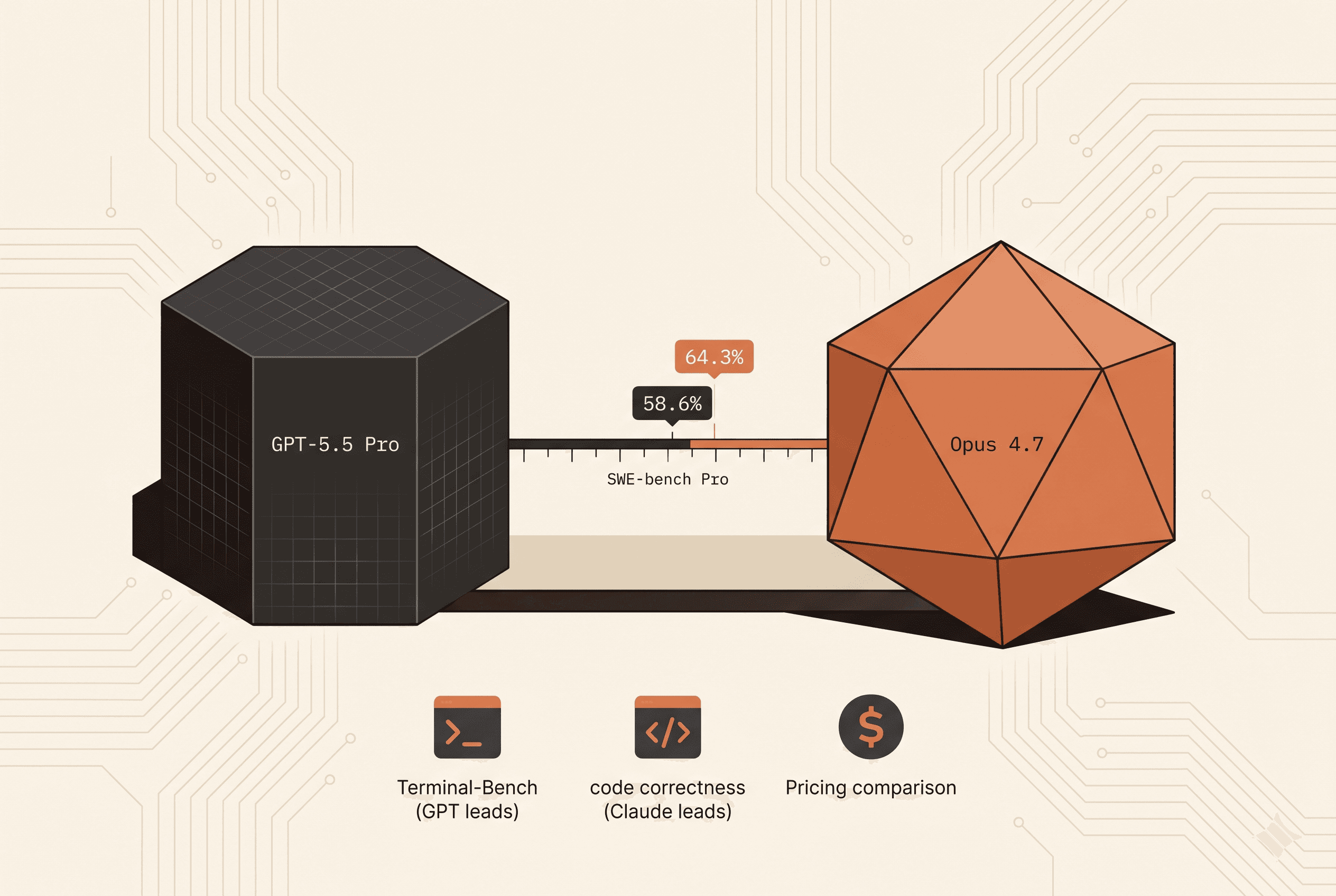
- Claude Opus 4.7 still wins on raw code correctness. SWE-bench Pro: Opus 4.7 at 64.3%, GPT-5.5 at 58.6%. SWE-bench Verified: Opus 4.7 at 87.6%.
- GPT-5.5 wins on agentic/terminal workflows. Terminal-Bench 2.0: GPT-5.5 at 82.7%, Opus 4.7 at 69.4%. If you spend your day running agents that execute shell commands and coordinate tools, GPT-5.5 has the edge.
- Pricing makes Opus 4.7 cheaper on output. Opus 4.7 is $5 / $25 per million, GPT-5.5 is $5 / $30. For output-heavy workloads (code generation, long reports), Opus 4.7 is about 17% cheaper on output tokens.
- GPT-5.5 Pro is 6x more expensive than GPT-5.5 on both input and output. You need a specific reason to justify it.
- For most Claude Code users, no switch is warranted. If you're not already running into Opus 4.7 limitations, GPT-5.5's agentic lead isn't enough to offset the ecosystem lock-in you'd take on by switching tools.
What's Actually New in GPT-5.5
OpenAI describes GPT-5.5 as their "smartest and most intuitive to use model" that "understands what you're trying to do faster and can carry more of the work itself." The specific areas highlighted are writing and debugging code, researching online, analyzing data, creating documents and spreadsheets, operating software, and moving across tools.
The technical gains that matter for daily use:
Agentic coding. GPT-5.5 shows meaningful improvement in coordinating multiple tools across a long task without losing the thread. This is the workload where "my agent ran for 40 minutes and produced a working output" becomes believable. Terminal-Bench 2.0 score of 82.7% is the public proof point.
Computer use. OpenAI specifically called out improvements in navigating computer workflows, including browsers and software UIs. If your use case includes any kind of RPA-style tool operation, GPT-5.5 handles it better than GPT-5.4.
Scientific research workflows. Mark Chen (OpenAI CRO) explicitly said GPT-5.5 "shows meaningful gains on scientific and technical research workflows" and "could really help expert scientists make progress." This is marketing-accurate, not marketing-inflated: the model is genuinely better at multi-step technical reasoning than 5.4 was.
Latency is preserved. OpenAI kept per-token latency the same as GPT-5.4 despite the capability upgrade. Moving from 5.4 to 5.5 doesn't slow anyone down.
What Claude Opus 4.7 Still Does Better
Raw code correctness on hard problems. SWE-bench Pro (multi-file GitHub issue resolution) is the clearest single benchmark for "the model writes code that actually works on real repositories." Opus 4.7 at 64.3% beats GPT-5.5 at 58.6% by about 6 absolute percentage points. On SWE-bench Verified, Opus 4.7 hits 87.6%. If your workload is "give the model a hard bug in a complex codebase and ask it to fix it," Opus 4.7 is still the better pick.
Output pricing. $25 per million output tokens versus $30 for GPT-5.5. On code generation or long reports, where the output tokens dominate, Opus 4.7 is measurably cheaper.
The Claude Code ecosystem. CLAUDE.md conventions, skill files, slash commands, plugin support, MCP integration, the primitive stack that makes Claude Code actually productive, none of that exists for GPT-5.5 in the same mature form. You can use GPT-5.5 via the OpenAI API or ChatGPT, but the dev tooling around it is less developed than the Claude Code stack.
Long-context quality. Both models offer 1M context windows, but Claude Opus 4.7 has documented 94-96% recall accuracy through 800K tokens. GPT-5.5's long-context recall is still being independently tested; OpenAI's claims are solid but haven't been reproduced in independent benchmarks yet at the time of this post.
The Pricing Math
Per-token costs, public list prices as of April 24, 2026:
| Model | Input (per 1M tokens) | Output (per 1M tokens) | Context window |
|---|---|---|---|
| GPT-5.5 | $5 | $30 | 1M |
| GPT-5.5 Pro | $30 | $180 | 1M |
| Claude Opus 4.7 | $5 | $25 | 200K (1M in Console) |
| Claude Sonnet 4.5 | $3 | $15 | 200K |
| Claude Haiku 4.5 | $1 | $5 | 200K |
For a typical coding workload (say 20k input tokens, 5k output per interaction, 100 interactions per day):
- GPT-5.5: $0.10 input + $0.15 output = $0.25 per interaction, $25 per day
- GPT-5.5 Pro: $0.60 input + $0.90 output = $1.50 per interaction, $150 per day
- Claude Opus 4.7: $0.10 input + $0.125 output = $0.225 per interaction, $22.50 per day
- Claude Sonnet 4.5: $0.06 input + $0.075 output = $0.135 per interaction, $13.50 per day
At that workload, Opus 4.7 is about 10% cheaper than GPT-5.5 and 85% cheaper than GPT-5.5 Pro. Sonnet 4.5 is the clear efficiency pick if the task doesn't need flagship reasoning.
When GPT-5.5 Pro's 6x premium over GPT-5.5 is actually worth it: narrow set of cases. Scientific research at the frontier of capability where you need the extra accuracy for correctness you can't easily verify. High-stakes legal or medical reasoning where errors compound expensively. Or agentic workflows with very long horizons (multi-hour runs) where a single hallucination derails the whole run. For normal coding and writing tasks, the premium doesn't earn its cost.
Decision Framework: Should You Switch From Claude?
If you're a Claude Code user running Opus 4.7 today, answer no to all of the below and you should stay put:
- Is your primary workload agentic terminal operation or RPA-style computer use? (If yes, GPT-5.5 may fit better.)
- Do you already have OpenAI ecosystem commitments (custom GPTs, the ChatGPT app, existing Responses API integrations)? (If yes, staying in one ecosystem is worth something.)
- Have you been specifically frustrated by Opus 4.7 output length limits or cost? (If yes, the calculation shifts.)
- Do you need ChatGPT's tool UI specifically (the sidebar, canvas, the integrations) for your workflow? (If yes, switch.)
If you answered yes to any, it's worth testing GPT-5.5 on a representative workload for a week. You can use the OpenAI API directly or upgrade your ChatGPT Pro subscription. Keep Opus 4.7 as your fallback.
If you're starting fresh and haven't committed to either stack: the current state of the art is that both Anthropic and OpenAI ship excellent flagship models. Opus 4.7 wins on raw coding quality, GPT-5.5 wins on agentic coordination. Pick based on ecosystem fit: if you want Claude Code and the primitive stack, Anthropic. If you want ChatGPT's product surface plus Responses API, OpenAI.
If you're a team lead making an infra decision for the next 12 months: default to Anthropic if your primary workload is coding, default to OpenAI if it's agentic automation or computer use. For any decision this size, actually run both models on your specific representative workload for 2 weeks before picking, because benchmark averages don't reliably predict your specific edge cases.
What This Means For Prompt Engineering
One thing that hasn't changed across this model release: prompt engineering still matters, and most "secret prompts" still work across both models.
The codes that shift reasoning (like /skeptic for premise-challenge or L99 for decisive commitment) work on both Opus 4.7 and GPT-5.5 with comparable effect sizes. The codes that are placebo on Claude (like GODMODE or 'you are an expert in X') are also placebo on GPT-5.5. Tone-changes are tone-changes regardless of model.
If you've been using a prompt library tuned for Claude, most of it transfers directly. The reasoning-shifter codes that work on Claude's architecture also work on GPT's. What doesn't transfer as cleanly: model-specific features like Claude's thinking modes, Anthropic-specific system prompt conventions, and the CLAUDE.md pattern. Those are Claude-native and don't have a clean GPT equivalent.
Honest Take
GPT-5.5 is a real upgrade. Not the "everything changed, now you must switch" marketing version, but a meaningful step up from GPT-5.4 that closes some of the gap Claude opened with Opus 4.6 and 4.7. For users in OpenAI's ecosystem, GPT-5.5 removes a lot of the "should I look at Claude" pressure that was building.
GPT-5.5 Pro at 6x the price is a narrower product. Most buyers don't need it. The cases where it actually earns its premium are at the frontier of what's possible with AI today, not at the middle of the distribution where most coding and writing tasks live.
For Claude Code users specifically, this release is not a reason to switch. Your Claude Code, CLAUDE.md, skills, and primitive stack continue to be the best-in-class developer experience. Opus 4.7 still wins the coding correctness benchmarks that matter most for software work. Your prompt library still works. The ecosystem lock-in you'd take on by switching is not offset by the benchmark improvements GPT-5.5 offers.
Watch the space. Anthropic will respond with Opus 5 or a 4.8-class model within 60-90 days. That release will likely reclaim the benchmarks GPT-5.5 briefly leads on (Terminal-Bench specifically, since that was explicitly called out as a win for OpenAI). The cycle continues.
Related Reading
- Claude Opus 4.7 vs 4.6 Benchmarks - what the current Claude flagship actually changed
- Claude Code Pro Pricing Test - the Anthropic tier drama from April 21-22
- Claude Code April 2026 Updates - the release notes from v2.1.113 through v2.1.117
- Claude Mythos Unauthorized Access Breach - the third big Anthropic story of the week
- Amazon Anthropic $25B Investment - the funding backing the next round of Claude models
Sources
- Introducing GPT-5.5 (OpenAI, April 23 2026)
- OpenAI releases GPT-5.5, bringing company one step closer to an AI 'super app' (TechCrunch)
- OpenAI launches GPT-5.5 just weeks after GPT-5.4 as AI race accelerates (Fortune)
- OpenAI's GPT-5.5 is here, and it's no potato (VentureBeat)
- GPT-5.5 vs Claude Opus 4.7: Benchmarks, Pricing & Coding Compared (Lushbinary)
- GPT-5.5 vs Claude Opus 4.7: Pricing, Speed, Benchmarks (LLM Stats)
- Claude Opus 4.7 Benchmarks Explained (Vellum)
- GPT-5.5 Released: First Fully Retrained Base Model Since GPT-4.5 (OFox)
Questions about which model to actually use for your workload? Reply on the newsletter and I answer every email.